
Regular vehicle maintenance—including oil changes, tire rotations, brake inspections, and transmission servicing—can significantly extend your car’s lifespan, often by hundreds of thousands of miles. Vehicles that receive consistent, professional care retain more of their value, perform more reliably, and cost far less to operate over time than those maintained reactively.
Most drivers don’t think about their vehicle’s health until something goes wrong. A warning light appears. A strange noise develops. A routine drive becomes a roadside emergency. The problem with that approach is that by the time symptoms surface, the damage is often already done—and the repair bill reflects it.
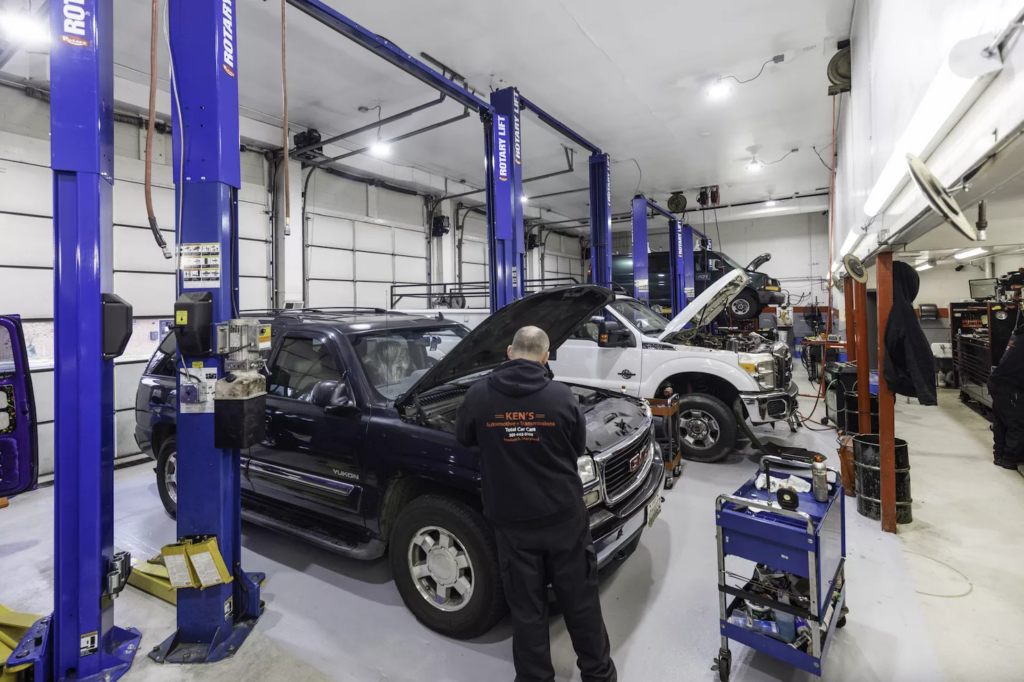
At Ken’s Automotive and Transmission, we’ve seen it all. Engines worn down by neglected oil changes. Transmissions that failed years too soon because the fluid was never serviced. Brake systems that became safety hazards because inspections were skipped. The pattern is consistent: deferred maintenance leads to accelerated wear, and accelerated wear leads to expensive, avoidable repairs.
The good news? A disciplined maintenance schedule doesn’t just prevent breakdowns—it actively extends how long your vehicle lasts and how well it performs along the way.
How Does Regular Oil Changes Protect Your Engine Long-Term?
Engine oil is the lifeblood of your vehicle. It lubricates moving parts, reduces friction, regulates temperature, and carries contaminants away from critical engine components. Over time, oil breaks down and becomes less effective—and when that happens, metal-on-metal contact accelerates wear at a rate most drivers would find alarming if they could see it happening.
The general recommendation has shifted in recent years, with many modern vehicles requiring oil changes every 5,000 to 7,500 miles, while synthetic oil formulations can extend that interval to 10,000 miles or beyond. What matters most is following the manufacturer’s specification for your specific vehicle and driving conditions—and not waiting until the oil looks black or a dashboard light appears.
At Ken’s Automotive and Transmission, oil change service includes a multi-point inspection that often catches developing issues before they escalate.
What Role Does Transmission Maintenance Play in Extending Vehicle Life?
The transmission is one of the most complex and expensive components in any vehicle—and one of the most neglected. Transmission fluid degrades over time, losing its ability to protect gears, clutch packs, and internal seals. When fluid breaks down or becomes contaminated, internal components wear faster, heat builds up more readily, and the risk of transmission failure increases substantially.
A transmission replacement or rebuild can cost anywhere from $2,500 to $8,000 or more depending on the vehicle. Routine transmission fluid service, by contrast, is a fraction of that cost—and in many cases, it’s what stands between a vehicle that runs for 15 years and one that requires a major repair at year eight.
As a transmission specialist, Ken’s Automotive and Transmission provides fluid exchange services, filter replacements, and full transmission diagnostics to keep this critical system performing correctly.
How Do Tire and Brake Maintenance Affect Overall Vehicle Health?
Tires and brakes operate under constant stress. Tires that are improperly inflated or out of alignment wear unevenly, which compromises fuel efficiency, handling, and safety. Regular tire rotations—typically every 5,000 to 7,500 miles—distribute wear evenly and extend tire life considerably.
Brakes are a safety-critical system, but they also affect other components. Worn brake pads that aren’t replaced promptly can damage rotors, which turns a relatively inexpensive pad replacement into a significantly more costly rotor replacement. Brake fluid, often overlooked entirely, absorbs moisture over time and can compromise braking performance—particularly in high-heat situations.
Consistent inspections of both systems catch deterioration early, when intervention is straightforward and affordable.
How Can Routine Inspections Prevent Costly Repairs Down the Road?
Beyond the major service intervals, routine inspections serve a function that’s easy to underestimate: they give a trained technician the opportunity to identify wear, leaks, cracking, or stress in components before failure occurs.
Belts and hoses degrade gradually. Coolant systems develop slow leaks. Suspension components wear in ways that aren’t always obvious to the driver until handling is already compromised. Battery health declines predictably with age and temperature cycling. None of these issues announce themselves clearly—but a professional inspection surfaces them while there’s still time to act at a lower cost.
This is where the relationship between a driver and a trusted local shop becomes genuinely valuable. Technicians who know a vehicle’s history can spot anomalies faster, make more accurate recommendations, and help owners plan for upcoming service needs rather than reacting to failures.
What Does Proactive Vehicle Care Mean for Resale Value?
Maintenance doesn’t only affect mechanical longevity—it has a direct impact on what a vehicle is worth when it’s time to sell or trade it in. Vehicles with documented service records command meaningfully higher resale values than comparable vehicles without them.
A prospective buyer or dealership evaluating a used vehicle is, in part, evaluating how it was cared for. A clean service history signals reliability. It reduces the perceived risk of purchasing the vehicle and justifies a higher price. Conversely, a vehicle with no records and deferred maintenance often sells at a discount—or doesn’t sell at all.
Maintaining a consistent service record at Ken’s Automotive and Transmission provides exactly that documentation.
Keep Your Vehicle on the Road Longer
The vehicles that last are the ones that are looked after consistently—not the newest ones, and not necessarily the most expensive ones. A 10-year-old vehicle with a clean maintenance history will often outperform a newer vehicle that has been neglected, both in reliability and in long-term cost.
Regular oil changes, transmission service, brake and tire maintenance, and routine inspections are not optional extras—they are the foundation of vehicle longevity. At Ken’s Automotive and Transmission, our team provides the expertise and thoroughness that drivers in our community depend on to protect their investment and stay safe on the road.
Schedule your next service appointment with Ken’s Automotive and Transmission and take the first step toward a vehicle that lasts.